

1.1 Digital vs Static Mobile Billboards
There are two main types on the road.
A static truck carries a printed vinyl banner. It is the cheaper option and still common for grand openings. A digital truck carries LED screens, which means the creative can change during the day and full-motion video is possible.
- Static truck: one printed message, lowest cost, no power system needed.
- Digital LED truck: video and rotating messages, GPS reporting, higher day rate.
- Hybrid setups: some operators mount LED panels and leave space for printed panels on the same rig.
1.2 How It Differs from a Fixed Billboard
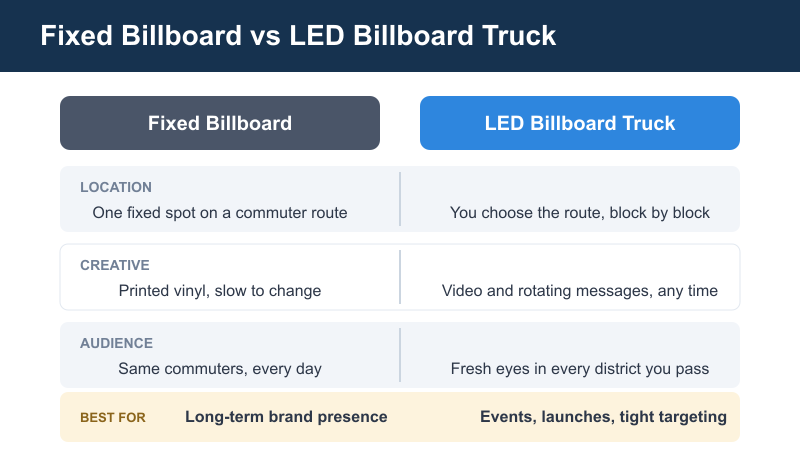
A fixed billboard waits for impressions at one spot. A truck goes looking for them. That single difference changes how you plan a campaign.
With a fixed hoarding, you buy a location. With a truck, you buy a route. You can circle a stadium before a game, loop a shopping district at lunch, or follow a competitor’s customers around a trade show. If you want a deeper look at the fixed side of things, our guide to digital LED billboard advertising covers static installations.
The tradeoff is dwell time. A driver passing a fixed billboard sees it every day on the commute. A truck reaches each viewer once, so the creative has to land fast.
2. LED Screen Specs That Matter on a Truck
Two trucks can look identical in a photo and perform nothing alike on a sunny street. As an LED screen maker, we care about four numbers in particular.
2.1 Brightness: Why 4,000+ Nits Is the Baseline
The screen fights daylight, not darkness. Vehicle-mounted outdoor screens call for at least 4,000 nits to stay readable at noon. Taxi-top LED screens, a good reference point because they live on the road full time, are typically rated at 4,000 nits or higher for exactly this reason.
Automatic brightness sensors matter too. A screen that stays blinding at night draws complaints and, in some cities, fines. A system that dims after sunset on its own is worth the small premium.
2.2 Pixel Pitch for Street Viewing Distances
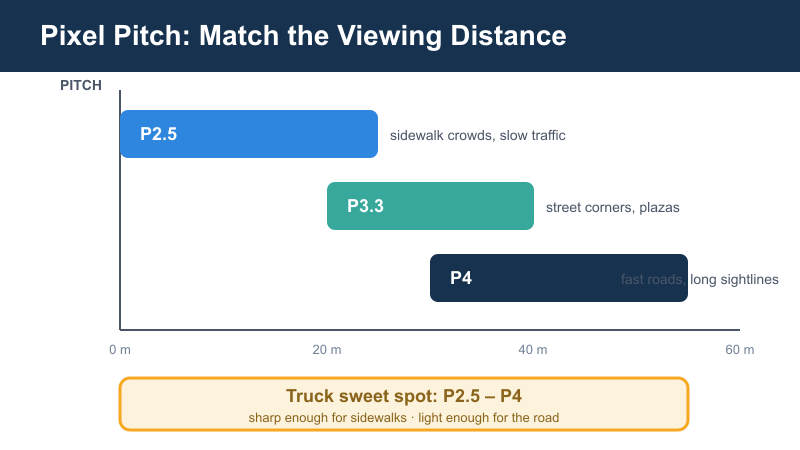
Pixel pitch is the gap between LED clusters, in millimeters. Smaller gap, sharper image up close.
Truck screens get viewed from 10 to 50 meters, so ultra-fine pitch is wasted money. The sweet spot for vehicle screens is P2.5 to P4: sharp enough for sidewalk viewing, coarse enough to keep costs and weight sane. Anything finer than P2.5 belongs on indoor walls, not on a highway.
2.3 Power: Generator and Vehicle Supply
The screens, players, and audio all draw power while the engine may be off. Complete trucks solve this with an onboard generator, and 15 kW is the common class because it carries three screens plus audio through a full shooting day.
Smaller vehicle-mounted screens sometimes skip the generator and run straight from the vehicle electrics. Commercial taxi screens, for instance, commonly accept a wide DC input of 9 to 36 volts, which lets one screen model fit cars, vans, and small trucks. Wide-voltage design also protects the screen when the vehicle system dips during engine start.
When you compare builds, ask what happens when the generator fails mid-campaign. A truck that can fall back to battery or engine power keeps its screens alive; one that cannot goes dark, and a dark truck earns no impressions.
2.4 Weatherproofing and Temperature Range
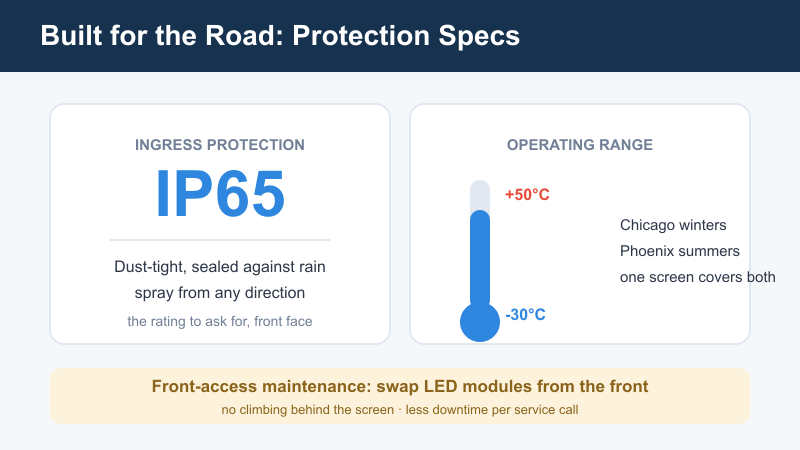
The screen lives outside at 60 mph. Front protection of IP65 is the standard worth asking for, meaning dust-tight and safe against rain spray from any direction.
Temperature is the other silent killer. A screen rated from -30°C to +50°C covers winter routes in Chicago and summer parking lots in Phoenix. Vehicle electronics also shake loose over time, so front-access maintenance (replacing modules from the front instead of climbing behind the screen) saves real money over a truck’s life.
Once the hardware makes sense, the next question is the one every buyer asks first: the price.
3. How Much Does an LED Billboard Truck Cost?
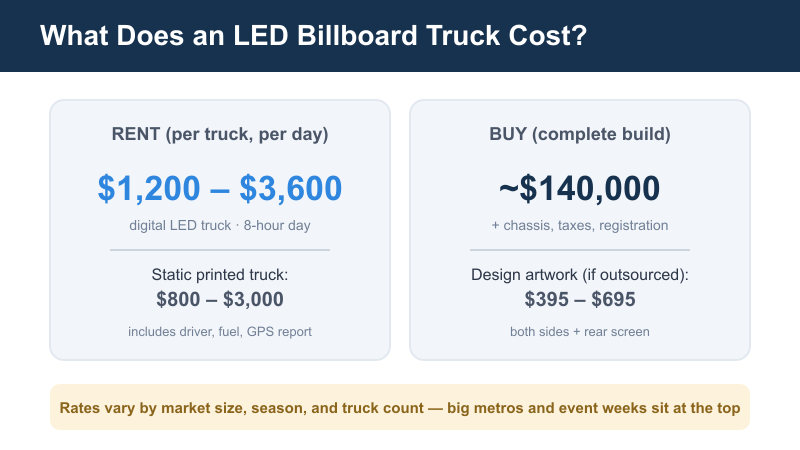
Short answer: renting runs $1,200 to $3,600 per day for a digital LED truck in most US markets, and buying a complete truck costs about $140,000 before chassis and taxes. The wide ranges come down to market size, truck count, and hours on the road.
Rates move with the city. A single truck in a mid-size market sits at the lower end. Major metros and event weeks, think Coachella or an election night, push toward the top and beyond.
3.1 Rental Rates
Operators across the US quote roughly the same numbers, so these ranges are safe for budgeting:
| Truck type | Typical day rate |
|---|---|
| Static (printed) truck | $800 – $3,000 |
| Digital LED truck | $1,200 – $3,600 |
A “day” is usually 8 hours. Extra hours get billed on top. Most quotes include the driver, fuel, basic routing, and GPS proof-of-performance reports.
3.2 Buying a Truck
Specialist builders sell complete digital LED trucks for around $140,000 as a package, with the chassis, taxes, and registration on top. That kind of build typically includes:
- A new truck chassis (the Chevy 3500 Express is a common base)
- Side screens around 6’4″ x 11’3″ plus a rear screen
- An onboard generator, usually 15 kW class
- Audio speakers, a rearview camera, and media players
Budget for the extras that do not appear in the brochure: commercial insurance, maintenance, storage, a driver’s wage, and permits for the cities you plan to work.
3.3 Creative and Setup Fees
Design work is usually separate. Having an operator design artwork for both sides and the rear screen typically costs $395 to $695. If your agency supplies print-ready or video-ready files, this line item drops to zero.
One tip from operators: confirm file specs before the shoot. Screen dimensions differ between fleets, and re-cutting a video for a different aspect ratio costs more than doing it right the first time.
4. Rent or Buy? A Decision Framework
Most brands should rent. Buying only pays off if the truck itself becomes part of your business. Here is the way operators and fleet owners usually frame it.
4.1 When Renting Makes Sense
Rent when advertising is the goal, not the truck.
- You have one campaign, launch, or event window
- You want different cities for different pushes, with zero logistics
- Your spend is a few thousand dollars a month, not tens of thousands
- You prefer someone else to handle drivers, insurance, and repairs
4.2 When Buying Makes Sense
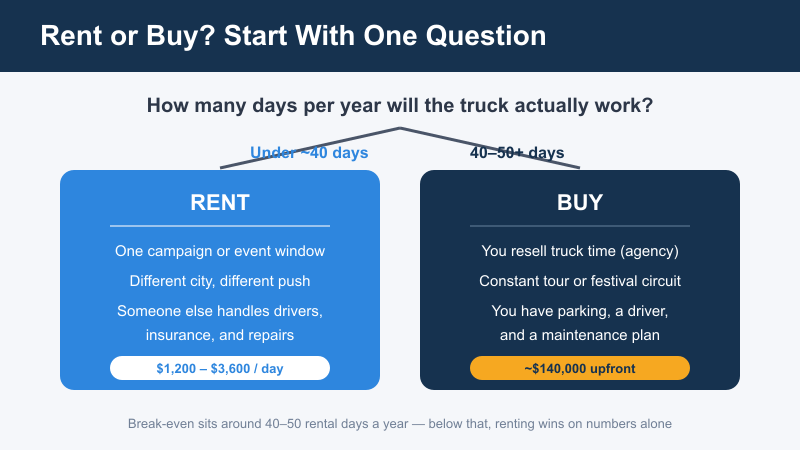
Buying starts to look sane around 40 to 50 rental days a year. Below that, the numbers rarely work.
- You run an agency or media business and will resell truck time
- Your brand tours constantly, for example a beverage or festival circuit
- You want the truck as a stunt prop that earns organic social coverage
- You have parking, a driver, and the patience for maintenance
4.3 Cost Comparison at a Glance
| Renting | Buying | |
|---|---|---|
| Upfront cost | None | ~$140,000 + chassis, taxes |
| Per-day cost | $1,200 – $3,600 | Fuel, driver, insurance, maintenance |
| Break-even point | Not applicable | Around 40-50 rental days per year |
| Multi-city flexibility | High, switch fleets per city | You drive it there yourself |
| Best for | Brands with campaigns | Operators and touring brands |
5. How a Campaign Works
The truck is only half the story. Routing and measurement separate a good campaign from a wasted one.
5.1 GPS Tracking and Proof of Performance
Serious operators log every route with GPS and hand over a report at the end: maps, timestamps, and where the truck sat still. This matters more than it sounds. It is how you prove the truck actually covered the streets you paid for.
Measurement usually stacks three layers:
- Impression estimates from traffic and pedestrian counts
- GPS route reports as proof of delivery
- Response tracking through QR codes, custom URLs, or promo codes
5.2 Creative Best Practices
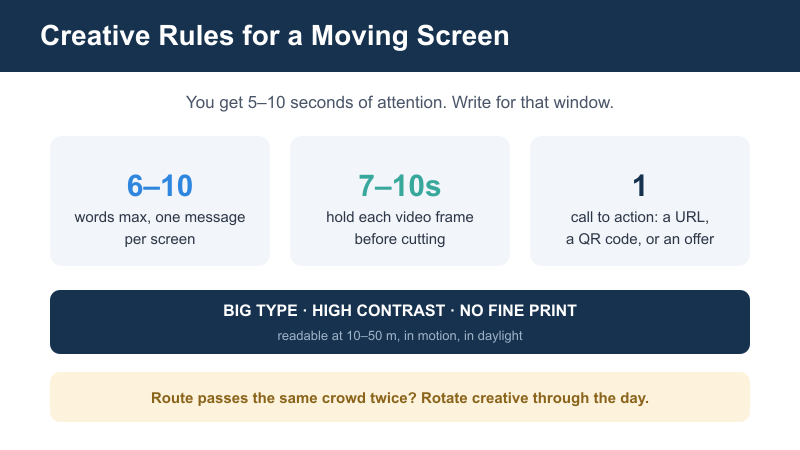
You get 5 to 10 seconds of a viewer’s attention. Write for that window.
- One message per screen, 6 to 10 words maximum
- Big type, high contrast, no fine print
- One call to action: a URL, a QR code, or a short offer
- For video, hold each key frame 7 to 10 seconds
- Rotate creative through the day if the route passes the same crowd twice
6. Where LED Billboard Trucks Get Used
The format shows up wherever a crowd forms and leaves on a schedule.
- Product launches and grand openings: loop the blocks around the store for launch week
- Sports and concerts: catch fans arriving and leaving, when they talk about what they saw
- Trade shows: circles the venue and hotel shuttles all day, cheaper than a booth corner
- Political and awareness campaigns: route through specific districts, with screens updating as the message changes
- Stadium-style advertising: for a fixed-venue take on big-screen ads, see our guide to the jumbotron screen
- Touring and car culture: mobile screens also appear at meets and shows
Event teams often pair the truck with a static presence on site. If that is your plan, our checklist for the concert LED screen covers the fixed-side setup.
7. Common Mistakes to Avoid
Operators see the same failures again and again. All of them are cheap to avoid in planning.
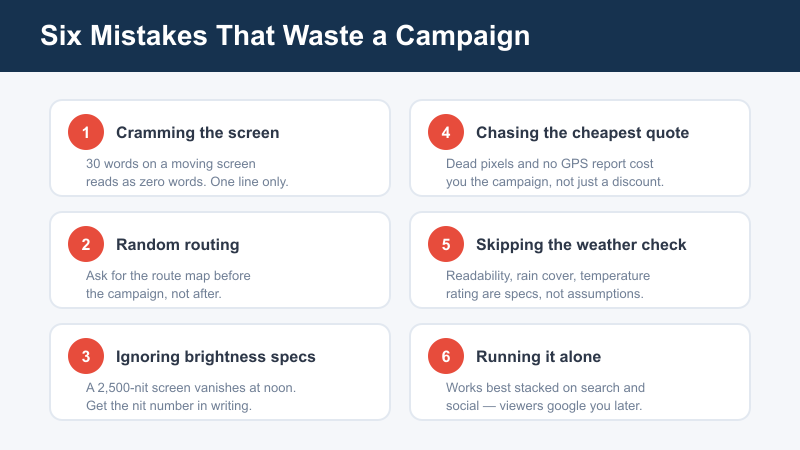
- Cramming the screen: 30 words on a moving screen reads as zero words. Cut it to one line.
- Random routing: driving busy roads without a plan wastes half the day. Ask for the route map before the campaign, not after.
- Ignoring brightness specs: a 2,500-nit screen vanishes at noon. Get the nit number in writing.
- Chasing the cheapest quote: an old truck with dead pixels and no GPS report costs you the campaign, not just the discount.
- Skipping the weather check: outdoor readability, rain cover, and temperature rating are specs, not assumptions.
- Running it alone: the format works best stacked on top of search and social, since people who saw the truck will google you later.
8. FAQ
How long is a standard rental day?
Eight hours is the standard day across most US operators, and extra hours get billed on top. Some campaigns split the day into two four-hour windows instead, which can help for commute-hour targeting.
Do I need special permits?
The operator handles route legality and parking rules as part of the service. Rules on idling, sound, and screen brightness vary by city, which is a good reason to use a company that has run your market before.
Can trucks show live video?
Yes. Screens take HDMI input from laptops, cameras, or streaming devices, so live feeds, social walls, and game streams all run fine on modern trucks.
How many people see a mobile billboard?
Operators estimate impressions from traffic and footfall data, and industry studies cited by out-of-home associations report strong recall for the format. Treat any precise “views per day” claim with caution and ask for the methodology behind it.
What pixel pitch is best for a truck screen?
P2.5 to P4 covers street viewing well. Finer pitch looks better in a showroom and worse on your invoice, while anything coarser than P5 starts to pixelate at sidewalk distance.
Planning a campaign or comparing truck builds? The screen is where cheap builds cut corners first. Contact us about LED screens for vehicle-mounted and mobile billboard applications, and we will walk you through the specs that matter for your routes.
