
Home » Colorlight i5 LED Display Receiving Card
Colorlight i5 LED Receiving Card
Colorlight i5 is a high-end receiving card for fine-pitch LED screens. It supports a high load capacity with up to 32 parallel or serial data groups. Its compact design fits small cabinets, and the DDR2 SODIMM interface allows easy integration into HUBs and display modules for flexible screen design.

Overviews

Colorlight i5 receiving card is a high-end product designed for fine-pitch LED displays. It offers high load capacity, compact design, easy integration, and excellent performance and stability. In addition to standard functions, it includes advanced features that enhance video performance, making it ideal for high-end LED display projects.
- High load capacity: supports up to 32 parallel or 32 serial data outputs
- Compact design: small body suitable for compact cabinet installation, saving space
- Easy to integrate: equipped with DDR2 SODIMM interface, can be easily integrated with HUB and display module
Technical Specifications
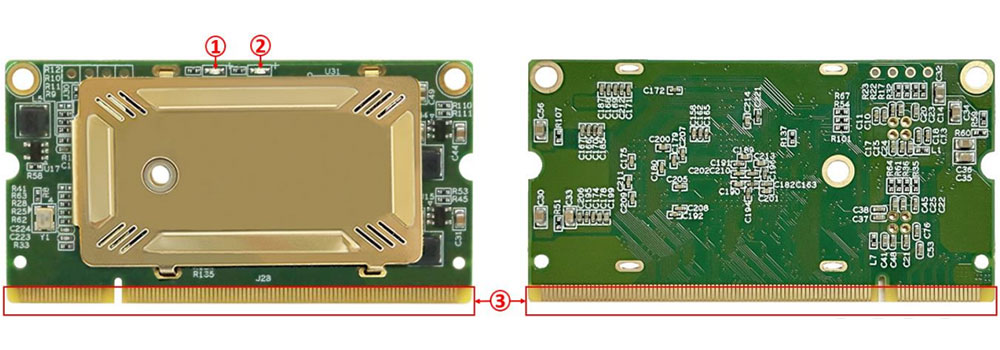
① Form Factor and Interface
● Dimensions: Measures a mere 68×36 mm, making it one of the smallest universal receiving cards available. This compact size facilitates high-density LED module design and slim cabinet profiles.
● Interface: Adopts a standard DDR2 SODIMM connector that plugs directly into a matching HUB board or motherboard, streamlining assembly and reducing wiring complexity.
② FPGA and Memory
● FPGA Core: Houses a Lattice ECP5U-25 FPGA, prized for its open-source toolchain support via Yosys and NextPNR, enabling hobbyists and developers to compile bitstreams without proprietary tool restrictions.
● RAM: Equipped with an 8 MB DDR2 SDRAM chip (EM638325BK-6H), providing sufficient frame buffering for high-resolution panels and smooth playback.
● Flash Storage: Integrates a 2 MB SPI Flash (GD25Q16CSIG) to store firmware and configurations, allowing in-field updates via Ethernet or USB without external programmers.
③ Connectivity Option
● Ethernet: Dual 10/100 Mbps Ethernet PHYs (Broadcom B50612D), offering redundant network paths for failover in daisy-chain topologies.
● USB: USB-C interface supports firmware upgrades and direct video input for diagnostics and offline playback.
● Debug Port: Onboard CMSIS-DAP debugger (DAPLink) provides JTAG and serial console access for developers, enhancing debugging and rapid prototyping.


Features of Colorlight i5
① Display Performance
- 8-bit video input for smooth, vivid color reproduction
- Adjustable color temperature to suit any environment or content
- 240 Hz refresh rate delivers flicker-free visuals, even under high-speed camera capture
- Enhanced low-brightness gray scale ensures clear detail and uniformity at minimal luminance
② Correction & Calibration
- Per-pixel brightness and chromaticity calibration achieves exceptionally uniform color and luminance across every panel
③ Maintenance & Usability
- On-screen display (OSD) & highlight function provide quick, intuitive status checks
- Screen rotation support for flexible installation orientations
- Data-group offset adjustment enables seamless module alignment and splicing
- Rapid firmware upgrades and fast correction-coefficient deployment minimize downtime
④ Reliability & Stability
- Loop-redundant network topology prevents signal loss in case of cable failure
- Real-time Ethernet cable monitoring for proactive fault detection
- Dual-boot firmware with readback safeguards against update errors
- 24×7 continuous operation designed for mission-critical, nonstop environments
Advantages & Limitations
Advantages
● Compactness: Eases cabinet design and enables thin, lightweight video walls.
● Open-Source FPGA Toolchain: Supports Yosys/NextPNR flows for custom logic and academic research.
● High-End Features: 240 Hz refresh, per-pixel calibration, and loop-redundancy set it apart from lower-end cards.
Limitations
● Memory Constraints: 8 MB buffer may limit extremely large or ultra-high-resolution panels when compared to cards with 16 MB or more.
● Bandwidth Ceiling: 10/100 Mbps Ethernet may become a bottleneck for future 8 K @ 120 Hz applications; upgrading to gigabit models would alleviate this.
Applications of Colorlight i5
Application 1. Stage and Event Rentals
Due to its portability, high refresh rate, and redundancy features, Colorlight i5 is a staple for touring AV companies. Panels built around i5 cards can be quickly assembled and reconfigured, delivering seamless video for concerts, festivals, and conferences.


Application 2. Fixed Installations
Retail billboards, stadium perimeters, and control-room video walls benefit from Colorlighti5’s per-pixel calibration and uniform brightness. Its low-profile design allows integration into narrow frames and curved surfaces without visual gaps.
Application 3. Broadcast and Virtual Production
240 Hz operation ensures compatibility with high-frame-rate cameras for virtual set extensions and real-time compositing. Colorlight cards’ stable timing and precise grayscale control support chroma keying and motion graphics with minimal artifacting.

Comparison with Other Colorlight i-Series Receiving Cards
| Feature | Colorlight i5 | Colorlight i5+ | Colorlight i8 | Colorlight i9+ |
| Dimensions | 68×36 mm | 68×36 mm | ≈85×60 mm | ≈85×60 mm |
| FPGA | Lattice ECP5U-25 | Lattice ECP5U-45 | Lattice ECP5U-45 | Lattice ECP5U-110 |
| DDR2 Memory | 8 MB | 16 MB | 16 MB | 32 MB |
| Ethernet | 10/100 Mbps | 10/100 Mbps | 10/100/1000 Mbps | 10/100/1000 Mbps |
| Data Groups | 32 | 32 | 64 | 64 |
| Refresh Rate | 240 Hz | 240 Hz | 384 Hz | 384 Hz |
| Per-Pixel Calibration | Yes | Yes | Yes | Yes |
| Loop-Redundancy | Yes | Yes | Yes | Yes |
| Price (est.) | ~$20-$30 | ~$45 | ~$60 | ~$75 |
Details

Specifications
Basic Parameters
| Control System Parameters | |
| Control Area | PWM chips: 512X384 pixels. Normal chips:512X256 pixels. Shixin: 512X324 pixels. |
| Ethernet Port Exchange | Supported, arbitrary use. |
| Grayscale | Up to 65536 grayscale. |
| Display Module Compatibility | |
| Supported Chips | PWM chips, normal chips, Shixin chips |
| Scan Type | Up to 1/128 scan |
| Module Dimension | Up to8192 pixels per data group. |
| Cable Direction | Route from left to right, from right to left, from top to bottom, from bottom to top. |
| Data Group | 32 groups of parallel RGB data and 32 groups of serial RGB data, the later can be extended to 128 groups. Data groups can be exchanged freely. |
| Data Folded | l Normal chips: 2~8 fold horizontally, 2~4 fold vertically. l PWM and Shixin chips: horizontal or vertical 2~8 fold. |
| Module pumping point, row and column | Any pumping point and any pumping row and any pumping column. |
| Monitoring Function (work with the module with corresponding sensor) | |
| Bit Error Monitoring | Monitor the total number of data packets and error packets to check network quality. |
| Pixel-to-Pixel Calibration | |
| Brightness Calibration | 8bit |
| Chromaticity Calibration | 8bit |
| Other Features | |
| Redundancy | Loop redundancy and firmware redundancy. |
| Optional functions | Shaped screen, etc. |
Equipment Specifications
| Physical Specifications | |
| Hardware interface | DDR2 SODIMM socket |
| Ethernet port transmission rate | 1Gb/s |
| Communication Distance | Recommended: CAT5e cable≤100m |
| Compatible with Transmission Equipment | Gigabit switch, Gigabit fiber converter, Gigabit fiber switch |
| Size1 | LXWXH / 67.6mm(2.66″)X35.5mm(1.40″)X4.2mm(0.17″) |
| Weight | 9.5g/0.02lbs, with heat sink. |
| Electrical specification | |
| Voltage | DC 3.8~5.5V, 0.5A |
| Rated power | 2.5W |
| Body Static Resistance | 2KV |
| Operating environment | |
| Temperature | -25℃~75°℃ (-13°F~167°F) |
| Humidity | 0%RH-80%RH, no condensation |
| Storage and transport environment | |
| Temperature | -40℃~125C (-40°F~257°F) |
| Humidity | 0%RH-90%RH, no condensation |
| Packing information | |
| Packaging rules | Standard blister box device, 6 cards per box, 600 cards per carton |
| Package size | WXHXD/550.0mm(21.65″)X180.0mm(7.09″)X398.0mm(15.67″ |
| Certification | |
| * RoHS certification, EMC Class A certification, EMC needs to work with the cabinet design, please contact technical support for assistance. | |
i5 Specification V2.1.2
Colorlight i5 LED Receiving Card
Get Quotation Now!
Related Products


Colorlight i5 LED Receiving Card : Performance & Specs Guide
The Colorlight i5, a stable and widely used LED receiver card, plays a crucial role in modern LED display systems. With its excellent signal transmission capabilities, high load capacity, and mature software support, the Colorlight i5 is widely used in indoor high-definition displays, commercial advertising screens, and fixed installation projects.

This article will focus on the core performance and technical parameters of the Colorlight i5, systematically analyzing its working principle, main specifications, and practical application advantages to help readers fully understand the value and adaptability of this LED receiver card in different display scenarios.
1. What Is the Colorlight i5 LED Receiving Card?
The Colorlight i5 LED Receiving Card is a core hardware component in LED control systems. Its primary function is to receive data signals from the transmitting card or video processor and precisely distribute them to each LED module for display. It acts as the data “execution terminal” for the entire LED screen, directly impacting image stability, clarity, and synchronization.

The Colorlight i5 boasts strong load capacity and stable data transmission performance, meeting the application requirements of medium-to-high resolution LED displays. Furthermore, this receiving card supports fine-tuning of key parameters such as grayscale, refresh rate, and brightness, and is highly compatible with Colorlight’s accompanying control software, facilitating system configuration and maintenance.
Therefore, the Colorlight i5 is commonly used in indoor fixed installations, commercial displays, and LED display projects with high requirements for image consistency.
2. Key Performance Advantages of Colorlight i5
Based on actual display needs, the Colorlight i5 demonstrates stable and balanced advantages in several aspects, primarily reflected in the following:
3. Technical Specifications
In LED display systems, technical parameters directly determine the compatibility and display performance of the receiver card. The Colorlight i5’s specifications balance stability and practicality, meeting the needs of most indoor fixed installations and commercial display projects.
Input and Output Specifications
The Colorlight i5 supports stable data input and output interface configurations, ensuring good compatibility with various Colorlight transmitter cards and video processing devices. Through standardized data interfaces, the receiver card can efficiently receive display signals and accurately distribute them to each LED module, ensuring smooth data transmission and accurate image synchronization across the entire screen.
Display Performance Parameters
In terms of display performance, this receiver card supports high refresh rates and grayscale levels, providing LED video wall with smooth brightness transitions and stable image output. This parameter configuration helps reduce flicker and color banding issues, making dynamic images and video content appear more natural and smooth.
Physical and Electrical Specifications
From a hardware design perspective, the Colorlight i5 adopts a compact structure, facilitating installation and wiring within standard LED cabinets. Meanwhile, its power supply and power consumption design meet the requirements of long-term operation, and can maintain stable performance within the specified working environment range, making it suitable for application scenarios with long-term continuous display.
Learn more about the specifications:
| Category | Specification |
| Physical Specifications | |
| Hardware Interface | DDR2 SODIMM Interface |
| Network Speed | 1Gbps |
| Communication Distance | Recommended Cat5e or above, ≤100m |
| Compatible Devices | Gigabit switch, Gigabit fiber transceiver, Gigabit fiber switch |
| Dimensions (L×W×H) | 67.6mm (2.66″) × 35.5mm (1.40″) × 4.2mm (0.17″) |
| Net Weight | 9.5g / 0.02lbs (including heatsink) |
| Electrical Characteristics | |
| Input Power | DC 3.8~5.5V, 0.5A |
| Rated Power | 2.5W |
| ESD Protection | 2KV |
| Operating Environment | |
| Temperature | -25°C~75°C (-13°F~167°F) |
| Humidity | 0%RH~80%RH, non-condensing |
| Storage Environment | |
| Temperature | -40°C~125°C (-40°F~257°F) |
| Humidity | 0%RH~90%RH, non-condensing |
| Packaging Information | |
| Packaging Type | Standard blister packaging, 6 cards per box, 600 cards per carton |
| Package Dimensions (W×H×D) | 550.0mm (21.65″) × 180.0mm (7.09″) × 398.0mm (15.67″) |
| Certifications | RoHS certified, EMC Class A certified. EMC requires proper enclosure design; please contact technical staff if needed. |
4. Common Applications of Colorlight i5
In practical projects, the Colorlight i5, with its stable performance and excellent system compatibility, is widely used in various LED display scenarios. Common applications include the following:

4.1 Indoor Fixed LED Display Screens
Suitable for conference rooms, control centers, corporate showrooms, etc., it can operate stably for extended periods, ensuring image synchronization and consistent display effects, meeting the needs of daily information display and meeting presentations.
4.2 Commercial Advertising and Retail Displays
Commonly used in shopping malls, brand stores, and shop window advertising screens, requiring high refresh rates and image detail, it enhances the clarity and visual appeal of advertising content.
4.3 Small to Medium-Sized High-Definition LED Display Projects
In applications such as corporate image display screens and indoor background screens, the Colorlight i5 supports higher resolution displays while simplifying system structure and improving overall installation efficiency.
4.4 Information Publishing and Public Display Systems
Suitable for announcement screens, wayfinding screens, and information publishing terminals, maintaining stable display under long-term operating conditions and reducing subsequent maintenance burden.
4.5 Multi-screen Splicing and Customized Display Solutions
Can be used with LED modules of different specifications to achieve flexible splicing, meet customized display needs, and are suitable for projects with special requirements for screen structure.
5. Installation and Configuration Guide
To ensure stable system operation and maximize display performance, the receiver card must be installed and configured according to standardized procedures. Proper installation and accurate parameter settings are crucial prerequisites for guaranteeing optimal LED display performance.
5.1 Installation in LED Cabinets
● Receiver Card Fixing and Location Selection: The receiver card should be installed in the designated fixed position inside the enclosure to ensure structural stability and facilitate future maintenance and replacement.
● Hardware Interface Connection Specifications: Connect the receiver card to the HUB board, LED modules, and power supply according to the system design requirements. Ensure a secure connection during insertion to avoid poor contact.
● Wiring and Interference Control: Signal lines and power lines should be properly separated to reduce the risk of electromagnetic interference and improve data transmission stability.
5.2 Software Setup and Configuration
● Device Identification and Basic Parameter Settings: The receiving card is identified using the accompanying control software, and basic parameters such as screen resolution, module size, and display orientation are set.
● Screen Mapping and Display Calibration: Screen mapping is performed according to the actual cabinet arrangement to ensure accurate image display position, and initial calibration of brightness and grayscale is completed.
● System Testing and Parameter Optimization: After configuration, an overall power-on test is conducted. Based on the display effect, relevant parameters are fine-tuned to ensure system stability and display consistency during actual operation.
6. Colorlight i5 vs Other LED Receiving Card
Colorlight’s I-Series receiver cards cover a range of models from basic to high-end, each differing in load capacity, refresh performance, and scalability. Comparing these models helps in selecting the control solution best suited to your project needs.
| Model | Colorlight i10 | Colorlight i9+ | Colorlight i8 | Colorlight i5+ | Colorlight i5 |
| Max Loading Capacity | 1024×384 pixels | 512×512 pixels | 512×384 pixels | 512×384 pixels | 256×256 pixels |
| RGB Data Outputs | 32 groups | 32 groups | 32 groups | 32 groups | 32 groups |
| Serial Data Support | Yes (up to 64 / expandable to 128) | Yes | Yes | Yes | Yes |
| Color Depth Support | Up to 12-bit | 8–10-bit | 8–10-bit | 8–10-bit | 8–10-bit |
| HDR Support | Yes | Yes | Yes | Yes | No |
| Calibration & Color Adjustment | Multi-level calibration | Multi-level calibration | Calibration supported | Calibration supported | Calibration supported |
| OSD & Status Monitoring | Supported | Supported | Supported | Supported | Supported |
| Smart Module Support | Yes | Yes | Yes | Yes | Yes |
| Card Size | Medium | Compact | Medium | Compact | Ultra-compact |
| Typical Applications | High-end fine-pitch LED displays | Rental & indoor displays | High-end fixed & rental displays | Cost-effective mid-size LED screens | Compact, entry-level LED screens |
7. How to Choose the Right LED Receiving Card?
In practical LED display projects, the choice of receiver card directly impacts system stability, display quality, and subsequent maintenance costs. To select a suitable LED Receiving Card, a comprehensive assessment can be made based on the following key dimensions:
First, select the load capacity based on the screen resolution and pixel density. Different receiver cards support different maximum pixel counts; ensure that the load capacity of a single card meets the screen resolution requirements to avoid insufficient load capacity leading to excessive screen partitioning or a complex system structure.
Second, pay attention to display performance parameters. Refresh rate, grayscale level, and color processing capabilities directly affect the smoothness and detail of the image. For scenarios such as commercial advertising and conference displays, prioritize models that support high refresh rates and stable grayscale output.

Third, consider the actual application scenario. Indoor fixed installations, rental displays, information dissemination, or high-end fine-pitch projects have different requirements for receiver cards. Clearly defining the usage environment and operating time helps in selecting a more suitable product specification.
Furthermore, system compatibility and software support are equally important. The receiver card should maintain good compatibility with the transmitting card, video processor, and control software to facilitate system configuration, debugging, and subsequent maintenance, reducing operational complexity.
Finally, stability and cost-effectiveness must be considered comprehensively. Only by selecting a receiver card that has been market-proven, operates stably, and has controllable maintenance costs, while meeting basic technical requirements, can a long-term reliable user experience be ensured for the LED display system.
8. FAQs
The Colorlight i5 is a common receiver card model in the Colorlight I series. It's primarily used to receive signals from transmitting cards or video processors and distribute the data to LED modules for display. It's suitable for small to medium-sized LEDs and indoor fixed installations.
The Colorlight i5 typically supports a maximum load capacity of approximately 256×256 pixels, suitable for LED displays of standard resolutions, ensuring both display quality and system stability.
This receiver card is widely used in indoor fixed LED displays, commercial advertising screens, corporate display screens, and information publishing systems, especially suitable for projects requiring stability and cost-effectiveness.
The overall installation and configuration process is relatively mature. Setup can be completed through standard interfaces and control software, making it suitable for routine engineering projects. Maintenance and debugging are relatively easy.
A comprehensive evaluation can be made based on factors such as screen resolution, display area, application scenario, and budget. If the project involves small to medium-sized indoor displays and requires stability and cost control, the Colorlight i5 is a suitable choice.
9. Conclusion
In conclusion, the Colorlight i5, as a stable and easy-to-use LED receiver card, demonstrates outstanding application value in small-to-medium-sized indoor displays, commercial advertising screens, and corporate display projects, thanks to its excellent load capacity, high refresh rate support, and reliable software compatibility.
Whether you prioritize stable operation or emphasize image detail and color consistency, the Colorlight i5 provides reliable hardware support for your LED display system.
If you are looking for a cost-effective, easy-to-install, and stable LED receiver card, consider the Colorlight i5. Contact us today for more technical support or to request a free sample, easily upgrading your display project to a professional level.
